Greek Numerology Calculator
Isopsephy is the ancient Greek art of finding the numeric value hidden inside every word. Enter a name or word — in English or in Greek — and reveal its sacred number.
The Ancient Art of Equal Pebbles
The word isopsephy comes from the Greek ἴσος (equal) and ψῆφος (pebble) — a memory of the way the Greeks once counted with stones. The system flowered in the Hellenistic and Byzantine worlds, where philosophers, mystics and theologians used letter-numbers to weave meaning out of the language itself.
Each of the twenty-four Greek letters carries a fixed numeric value. Three archaic letters — Stigma, Koppa and Sampi — were preserved purely as numeric placeholders so that every value from 1 to 999 could be written. Sum the letters of a word and you obtain its psephos: a single number that opens the word to symbolic and philosophical reading.
The most famous resonances are still discussed: Ἰησοῦς (Jesus) equals 888; Ἀβρασάξ equals 365 (the days of the solar year); the "number of the beast" in Revelation, 666, uses the very Greek verb ψηφισάτω — "let him calculate."
Enter a Word
Type any name or word — English letters are mapped phonetically to their Greek equivalents.
How Isopsephy Works
Map letters to values
Each Greek letter has a fixed numeric value: Α=1, Β=2, … Ι=10, Κ=20, … Ρ=100, Σ=200, … Ω=800, Sampi=900.
Sum every letter
Add the values of every letter in the word. The result is the psephos — the numeric signature of that word.
Read the resonances
Reduce to a single digit, look up its meaning in the Pythagorean Decad, and search for other words sharing the same value.
The Greek Numeric Alphabet
24 living letters plus three archaic numerals (Stigma, Koppa, Sampi) preserved purely for arithmetic.
The Ten Sacred Numbers
For the Pythagoreans, every number from 1 to 10 carried a personality, an archetype and a cosmic role.
Words With a Story
Fifteen historically significant words and the numbers they carry.
Number as the Soul of Things
"All things are number," taught Pythagoras. For his school the cosmos was a single great kosmos — an ordered whole — held together by the harmonic ratios of small integers. Music, planetary orbits, the human soul and the alphabet itself were all expressions of this hidden numeric architecture.
Isopsephy was one of the keys. By reducing language to number, the practitioner was not playing a game but listening for the underlying chord on which all reality is tuned.
Frequently Asked Questions
Isopsephy (Greek: ἰσοψηφία, "equal pebbles") is the ancient Greek practice of summing the numerical values of the letters of a word. Each Greek letter has a fixed numeric value, and any word, name or sentence can therefore be reduced to a single number that opens it to symbolic interpretation.
They are sister systems. Hebrew gematria uses the 22 Hebrew letters with their numeric values; Greek isopsephy uses the 27 Greek letters (24 standard plus three archaic letters retained for numerics). The methods are nearly identical; only the alphabet differs.
Three archaic letters — Stigma (Ϛ = 6), Koppa (Ϟ = 90) and Sampi (Ϡ = 900) — fell out of phonetic use but were preserved in Greek mathematics as numeric symbols. Without them you cannot represent every value from 1 to 999.
Yes. The calculator detects whether your input is in Greek or in Latin script and applies a phonetic mapping (A → Α = 1, B → Β = 2, etc.) for English. For the most authentic result, enter the original Greek spelling.
Because they are different spellings. "Jesus" in Latin script is five letters (J·E·S·U·S) which map phonetically to Ι·Ε·Σ·Υ·Σ = 815. The historical isopsephic value of 888 belongs to the original Greek spelling Ἰησοῦς — six letters including the eta (η = 8) and omicron (ο = 70) that English orthography drops. This is why isopsephy is traditionally performed on the Greek originals: every "extra" Greek letter changes the sum. Click any word in the Famous Resonances section to load its Greek spelling and see 888 directly.
Revelation 13:18 calls 666 "the number of the beast" and uses the verb ψηφισάτω — the same root as isopsephy. Many candidates have been proposed for which name sums to 666; the most historically supported is "Nero Caesar" written in Hebrew letters.
The Greek spelling of Jesus, Ἰησοῦς, sums to 888 (10 + 8 + 200 + 70 + 400 + 200). Early Christian authors saw this as profoundly significant: 8 represents the eternal "eighth day" beyond the seven of creation, and 888 is its triple intensification — the cosmic Christ.
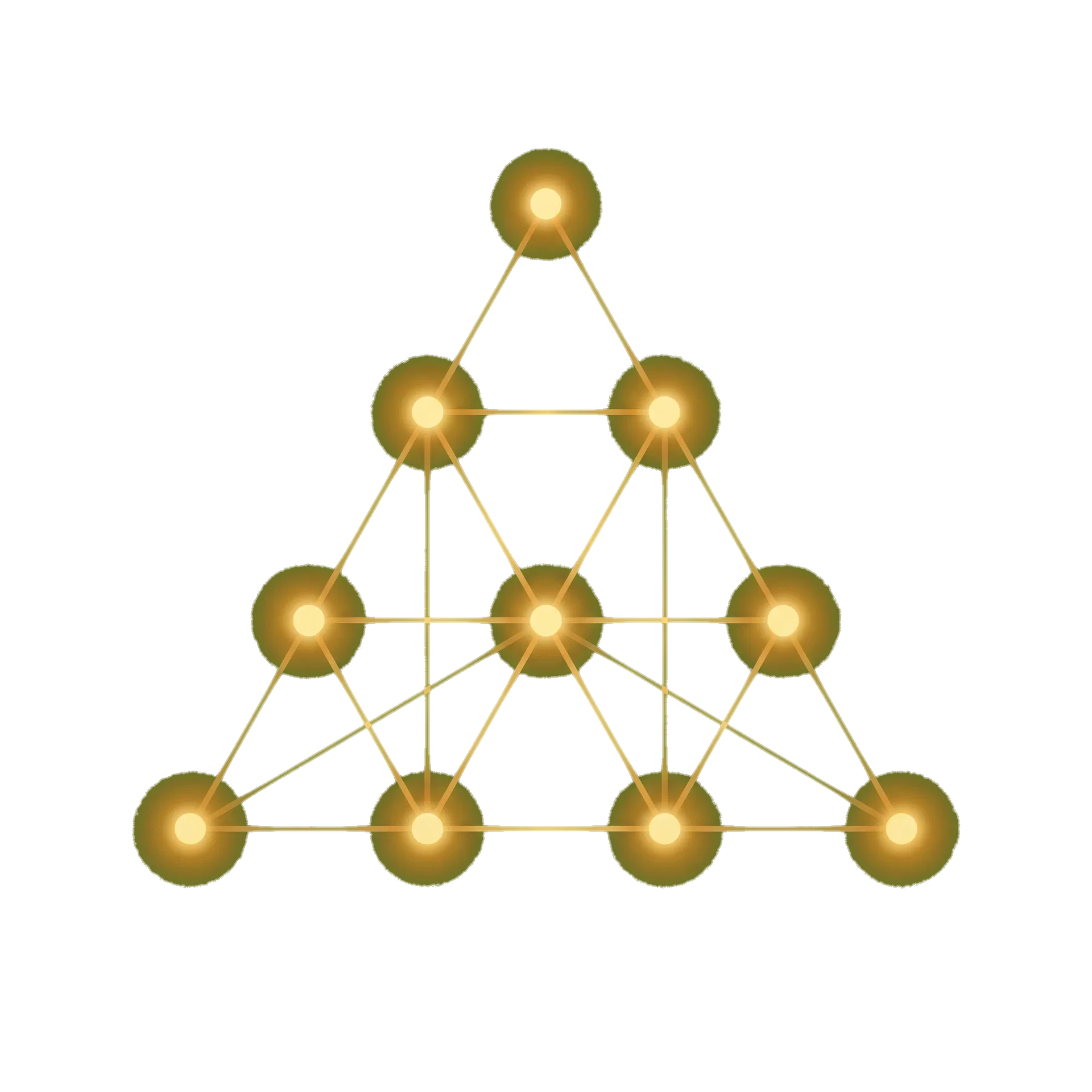
The Tetractys is a triangular figure of ten dots arranged in four rows (1 + 2 + 3 + 4 = 10). For the Pythagoreans it represented the geometric harmony of the cosmos and was considered so sacred that disciples swore oaths upon it.
Find the Number of Your Name
Every word carries a number. Every number carries a meaning. Discover yours in seconds — the way Pythagoras' students did, two and a half millennia ago.